

Never Again Is an Inheritance
Bearing witness to ICE as a Jewish American

As a Jewish American woman, I grew up with pain as identity and persecution as inheritance. It was given to me through both genes and upbringing — nature and nurture, blood and story. The lesson was not subtle. It was explicit, repeated, ritualized: this happened to us, and because it happened, we must never let it happen again.
But this is not about antisemitism. Not directly.
This is about the legacy of persecution — and what never again means when it is happening again and a large segment of the population refuses to see it.
I was taught that never again was not a slogan. It was a warning and a responsibility. It meant recognizing harm early — not waiting for its most grotesque form. It meant understanding that atrocities do not begin with camps or uniforms, but with paperwork, rationalizations, selective enforcement, and silence. With people telling themselves it’s legal, it’s different, it’s exaggerated, it’s not my place.
I was taught that if I had lived then, I would have spoken up. That we would have known better. That history had taught us how this starts — so we would recognize it while there was still time to intervene.
And now I am watching families targeted at work, at school, in their homes, in their communities. I am watching people live with the ambient fear of being made to disappear. I am watching neighbors explain this away as law enforcement, as policy, as politics — as if legality has ever been a moral defense.
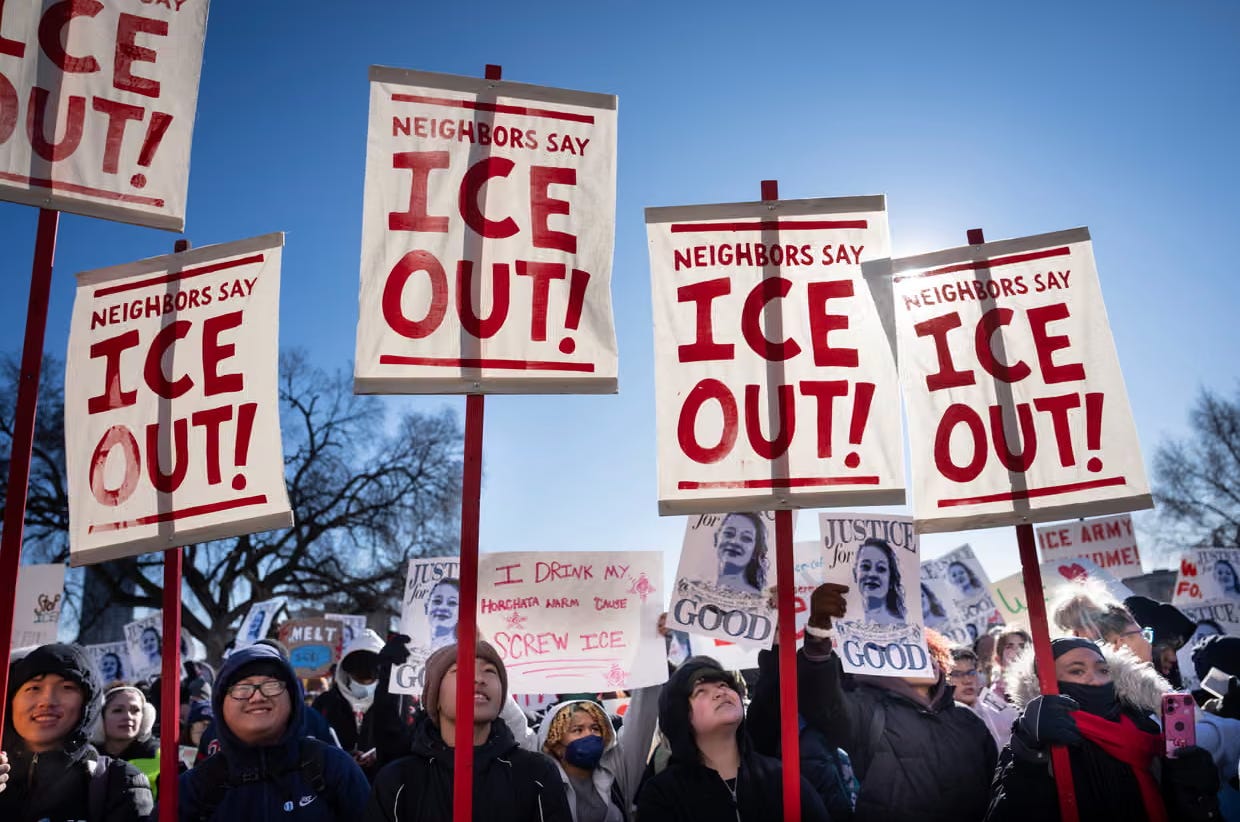
I am talking about ICE raids separating families. About mass deportation policies targeting undocumented immigrants. About children afraid to go to school because their parents might not be there when they return. About communities told they are criminals, that they deserve this, that their fear is a consequence they chose.
And I keep thinking: isn’t this how it always starts?
Not with the end result we recognize in textbooks. But with fear normalized. With communities learning to stay quiet. With cruelty reframed as order. With harm explained away by people who insist that drawing historical parallels is irresponsible, hysterical, or offensive.
I understand the arguments. I understand that history never maps perfectly onto the present. But moral recognition does not require perfect equivalence — it requires pattern recognition. And the patterns are painfully familiar.
What I hear now — it’s breaking the law, it’s not the same, stop making everything about the past — are not new arguments. They are the oldest ones. They are the same justifications used every time we look back and ask how something so obviously wrong was allowed to happen.
And that question is what haunts me now:
Why didn’t it stop earlier?
Why didn’t more people speak?
Why did so many wait until it was undeniable — and therefore irreversible?
We were told this time would be different because we know. Because we remember. Because we teach our children what happened and swear it will never happen again.
So what does never again mean if it only applies once the harm is complete? What does it mean if it requires perfect replication before it counts?
I am heartened —inspired— by the people who are speaking up. I am grateful for those who refuse to normalize cruelty or explain it away. And at the same time, I am devastated that recognition is not universal — that it so often falls to those whose bodies and histories already carry the memory of what persecution looks like before it has a name everyone agrees on.
This is not about claiming everything is the same. It is about refusing to pretend the core mechanism is unfamiliar: a people singled out, fear made ambient, disappearance justified, and silence encouraged through exhaustion, denial, and the comfort of distance.
That recognition is not hysteria.
It is inheritance.
If we cannot learn here — at the point where harm is still debated rather than fully realized — then when were all those lessons meant to matter?
Never again was not supposed to be retrospective.
It was supposed to be preventative.
I don’t know what to do with that grief yet. But I know that silence isn’t an option. That waiting until everyone agrees isn’t an option. That never again only means something if we are willing to be uncomfortable — to speak when it is still debatable, when we might be wrong, when people tell us we are overreacting.
Because if we wait until we are sure, it is already too late.
For more, visit my website, my instagram, and check out my books.

And as always, let me know what you think.
Thank you for writing this